Extensive description of site:
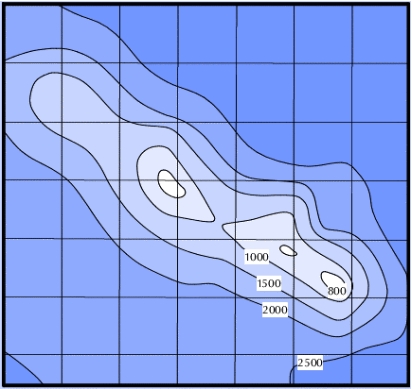
The Sedlo Seamount, about 180 km north of the Azores, Sedlo has an elongated shape with three summits rising from
nearly 3000m to a little more than 700m below sea level. It is thought to be little, if ever, affected by human activities.
summit of Sedlo shows large areas of bare rock, sometimes with a thin layer of sediment, and also bolders and stones
of different size. |
Habitats present:
| Deep-Sea Bed | Rock | Sand | Mud | Bioherm | Benthopelagic | Water Column |
| Continental Margin | | | | | | Epi-pelagic X |
| Abyssal Plain | | | | | | Mesopelagic X |
Seamounts and
Oceanic Islands flanks | X | X | | | X | Bathypelagic X |
Chemosynthetic
environments | | | | | | Abyssopelagic |
|
Description of fauna and flora:
On the rock we find a variety of attached-living animals, for example sponges, black corals, stony corals, sea lilies, and
sea anemones, as well as moving animals such as seastars and crabs. Shrimps and fish, particularly sharks and
deep-sea eels, swim close to the seabed. Only a few colonies of coral have been seen on Sedlo, the largest about the
size of a frying pan. Single seagulls, shearwaters, and storm petrels were observed, as well as a few sea turtles and
dolphins. During the night, it was observed large squid and Atlantic saury. |
Habitat description:
Habitats according to EUNIS classification:
A6.22 Summit communities of seamount, knoll or bank within the mesopelagic zone, i.e. interacting
with diurnally migrating plankton
A6.24 Flanks of seamount, knoll or bank
A6.25 Base of seamount, knoll or bank |
Facilities:
The nearest harbour is located 80 miles away (Praia da Vitória); an oceanographic vessel is therefore needed. R/V
“Arquipélago” is available to produce scientific work in the area (see specifications at:
http://www.horta.uac.pt/equipment/ships_1.html). Not accessible during winter. If scientists are outside the
Archipelago, there are flights from Lisbon to one of the islands and then a research vessel to the sites. Good port
facilities in at least three islands of the Archipelago: Faial; S. Miguel and Terceira. DOP-UAç laboratories (including
LabHorta) might be used as a shore support base (distance – 150 miles). |
Links:
|
Commitment and ongoing research:
There is an European funded project named OASIS (EVK-CT-2002-00073-OASIS) which is comparing this seamount
to the Seine seamount. The project will continue until the end of 2005. |
Additional Information:
Melo, O. and G. Menezes 2002. Projecto de acompanhamento da experiência de pesca dirigida ao peixe-relógio
(Hoplostethus atlanticus). Relatório final. Arquivos do DOP, Série Estudos, 4: 38p. + Anexes. |