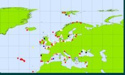
Molecular methods such as DNA/eDNA metabarcoding have emerged as useful tools to document the biodiversity of complex communities over large spatio-temporal scales. We established an international Marine Biodiversity Observation Network (ARMS-MBON) combining standardised sampling using autonomous reef monitoring structures (ARMS) with metabarcoding for genetic monitoring of marine hard-bottom benthic communities. Here, we present the data of our first sampling campaign comprising 56 ARMS units deployed in 2018-2019 and retrieved in 2018-2020 across 15 observatories along the coasts of Europe and adjacent regions. We describe the open-access data set (image, genetic and metadata) and explore the genetic data to show its potential for marine biodiversity monitoring and ecological research. Our analysis shows that ARMS recovered more than 60 eukaryotic phyla capturing diversity of up to similar to 5500 amplicon sequence variants and similar to 1800 operational taxonomic units, and up to similar to 250 and similar to 50 species per observatory using the cytochrome c oxidase subunit I (COI) and 18S rRNA marker genes, respectively. Further, ARMS detected threatened, vulnerable and non-indigenous species often targeted in biological monitoring. We show that while deployment duration does not drive diversity estimates, sampling effort and sequencing depth across observatories do. We recommend that ARMS should be deployed for at least 3-6 months during the main growth season to use resources as efficiently as possible and that post-sequencing curation is applied to enable statistical comparison of spatio-temporal entities. We suggest that ARMS should be used in biological monitoring programs and long-term ecological research and encourage the adoption of our ARMS-MBON protocols.
All data in the Integrated Marine Information System (IMIS) is subject to the VLIZ privacy policy